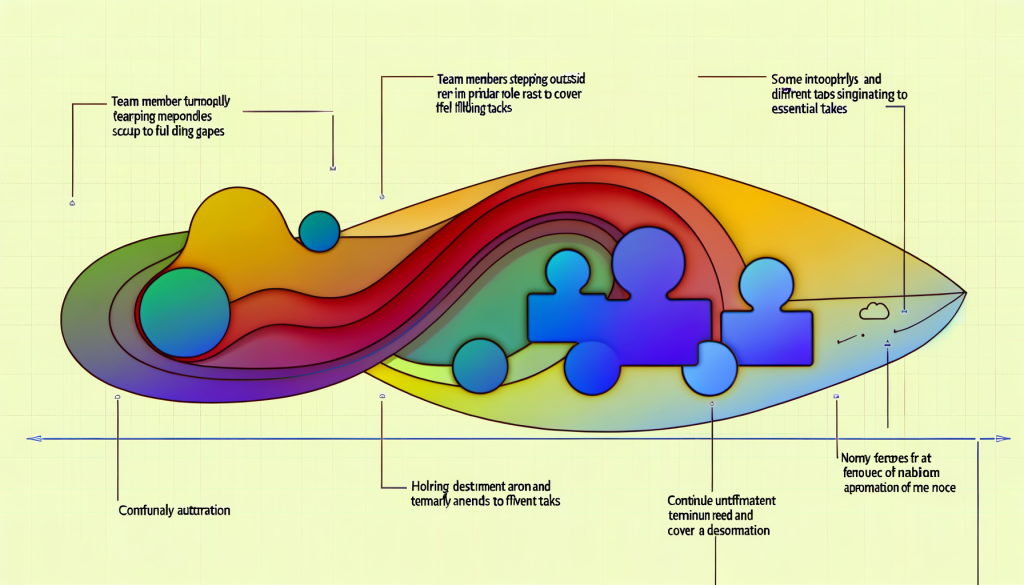

Every startup I’ve been part of or advised has operated in a state of chronic functional incompleteness. The work required to survive and grow always exceeds the formally staffed roles available to perform it. This isn’t a failure of planning or hiring ; it’s a structural feature of early-stage companies. There is always more essential work than there are people whose job descriptions cover it. And so people stretch. They pick things up. They become the de facto owner of things no one asked them to own. This is not only normal, it’s necessary. But the way organizations handle what happens *after* someone picks something up is what separates companies that scale from companies that calcify.
The Lifecycle of a Gap
In a startup, team members temporarily occupy multiple fluid roles, often far outside their title or expertise, to cover essential organizational gaps. A backend engineer becomes the person who triages customer escalations. A product manager starts managing vendor contracts. The CTO ends up running weekly all-hands because no one else has the context to do it yet. These are adaptive responses to unmet needs, and they should be treated as exactly that : not as permanent identity claims. The danger comes when temporary coverage quietly hardens into assumed ownership, when the person who picked something up becomes “the person who does that” indefinitely, not because it’s the right long-term answer, but because no one paused to ask whether it should live somewhere else.
I’ve found that the most effective organizations periodically audit this. They look at recurring informal work and make a deliberate decision: formalize it into a real role, automate it, or consciously eliminate it. This is the lifecycle of a gap : it gets detected, covered, made legible, and eventually moved to its right long-term home. When this lifecycle works well, individuals shed temporary roles and redirect their effort toward newly emerging gaps, which there are always plenty of. When it doesn’t work, you end up with senior people buried under accumulated responsibilities that no longer match their highest-value contribution, and they burn out not from the difficulty of their actual job, but from the weight of every job they accidentally inherited along the way.
The Three Things Strong Startup Employees Do
The mature behavior in a startup is not merely picking things up. It is stewarding roles through their lifecycle. I’ve observed that the strongest early employees consistently do three things, and the third is the most important and least celebrated:
- They cover the gap. They step in when needed, without waiting for permission or a title change. This is the part most people recognize and reward.
- They make the gap legible. They document the work, define the problem, and show that the job is real. They translate invisible labor into something the organization can reason about. This is harder than it sounds ; much of the most critical gap-filling work in startups is invisible precisely because the person doing it is competent enough to make it look effortless.
- They try to make themselves unnecessary. They actively help the company move the work to the right long-term home, whether that’s a new hire, a tool, a process, or a decision to stop doing it entirely. This requires a kind of ego-lightness that is rare and should be explicitly valued.
That last step , working to hand off what you’ve built or maintained , runs counter to how most organizations implicitly reward people. We tend to celebrate ownership and empire-building. But in a startup, the person who gracefully transitions a function they’ve been carrying to its proper long-term owner is creating enormous value, even though it looks like they’re giving something up. As I’ve written before, the difficulty is the point , and the difficulty here is emotional, not technical. Letting go of work you’ve made your own requires confidence that your value isn’t defined by what you currently hold.
Practical Rules for Managing Functional Gaps
Over time I’ve arrived at a set of principles that I think hold true across most early and growth-stage companies. None of them are complicated, but all of them are easy to forget when you’re moving fast:
- Do not confuse who is doing the work with who should own it long term. Temporary coverage is healthy. Permanent ambiguity is not. The fact that someone *can* do something well does not mean they *should* keep doing it indefinitely.
- Repeated extra work is usually a signal of a missing function. If the same “miscellaneous” work keeps appearing on someone’s plate, it is not miscellaneous anymore. It’s a real job that doesn’t have a home yet.
- A startup’s org chart always lags reality. Actual work patterns form before formal structure catches up. This is fine as long as leadership periodically reconciles the two. It becomes a problem when the gap between the official structure and the real structure grows so large that planning decisions are based on a fiction.
- The best early employees are role-flexible but ego-light. They will pick up needed work without needing to own it forever. I’ve found this combination to be one of the strongest predictors of who thrives in early-stage environments and who struggles : not technical skill, not domain expertise, but the willingness to hold things loosely.
- Every temporary role should have an exit condition. When someone picks up gap work, three questions should be asked early: When does this move? To whom? What must be true first? Without these answers, temporary becomes permanent by default.
- Hiring is partly the conversion of informal labor into formal ownership. A good hire does not just add capacity. It absorbs unstable responsibilities that are currently living inside other people. This reframing changes how you write job descriptions, how you evaluate candidates, and how you measure whether a hire was successful.
- As specialization increases, new integration gaps appear. This one surprises people. More defined roles do not eliminate gap work ; they create new seams between functions that also need owners. The nature of the gaps changes as you grow, but the gaps themselves never go away.
Startup effectiveness depends not on static role clarity, but on the organization’s ability to continuously detect, cover, formalize, and reallocate critical functions as conditions change. The companies that do this well develop an almost rhythmic quality to their growth : roles stretch, work becomes visible, ownership transfers, and people redirect toward the next set of emerging needs. The companies that don’t do this well accumulate invisible debt in the form of overloaded individuals, unclear ownership, and a growing sense among the team that the organization’s structure doesn’t reflect how work actually gets done. That debt compounds quietly until it doesn’t ; until someone essential burns out, or a critical function falls through a crack that everyone assumed someone else was covering. The discipline of stewarding roles through their lifecycle isn’t glamorous work, but it may be among the most important operational habits a growing company can develop.